

Tgħallem dwar Raġġ Deflessjoni Teknoloġija Ibbażat fuq Spazju Ottiku Komunikazzjoni fi 3 Minuti
Dec 29, 2023
Raġġ deflessjoni teknoloġija is a ċavetta komponent ta ' spazju liberu laser komunikazzjonijiet, u its prestazzjoni jiddetermina jekk spazju liberu laser komunikazzjonijiet can meet u stabbli komunikazzjoni bżonnijiet. Beam deflessjoni teknoloġija can be divided fi żewġ kategoriji: mekkaniku raġġ deflessjoni teknoloġija u mhux mekkaniku raġġ deflessjoni teknoloġija. Among them, mechanical beam deflection technologies include scanning galvanometers, fast control mirrors, and micro-electromechanical system deformable mirrors; non-mechanical beam deflection technologies include acousto-optic deflection technology, deflection technology deflection technology 2c deflection technology based on liquid crystal materials, and electro-optical deflection technology.
1.Scanning galvanometer
The most mature mechanical beam deflection device is a scanning galvanometer, which is essentially a light reflector with a step response time of milliseconds/sub-milliseconds and a pointing accuracy of microradians, as shown in Figure 1.

Figura 1 Skematika dijagramma ta ' skannjar galvanometru
Il- galvanometer scanning system has a simple structure, small size, high scanning accuracy, fast speed, and relatively low cost. However, it has problems such limited working range, pincushion distortion, and galvanometer wear. This device has reached excellent performance standards in terms of deflection angle. For example, the XG210 series scanning galvanometer launched by the American THORLABS company has a deflection angle angle of up to ±20 degree . Bħalissa, riċerkaturi at home and abroad are working on increasing the scanning speed and using methods such as femtosecond laser pulses and multi-dimensional galvanometer structures to improve its its performance.
Madankollu, għal bidimensjonali galvanometri u dimensjonali ogħla galvanometer scanning technologies, the system structure is more complex, and orientation errors will occur in practicecal applications, and good correction methods are required to correct the errors. In the future, we can consider using variable structure control technology and thick and thin two-level composite axis control technology control technology control control technology to assist in suppressing residwu żbalji. Huma jistgħu jkunu jiġu applikati in satellita kostellations with good space environments and short working cycles to achieve high-precision tracking and scanning with maximum efficiency. In addition, the power of lasers in laser communications is generally very high, so choosing galvanometer mirror materials with higher reflectivity to reduce surface damage is also a problem that needs to be solved in the future.
2.Fast Steering Mirja
Hemm żewġ strutturi għal Fast Steering Mirrors, FSM (as shown in Figure 2): one is the X-Y axis frame structure, also called the shaft system structure; the other is is the flexible axis structure, li is is the main development direction of FSM at present.


Figure 2 (a) X-Y axis frame structure diagram of the Fast Steering Mirrors; (b) Flexible axis structure diagram of the Fast Steering Mirrors
Il- fast control mirror has the advantages of high positioning accuracy, high angular resolution, fast response speed, and compact size. It is widely used in a variety of optomechanical systems, and the flexible support structure also reduces mechanical friction, but in practicecal applications it requires Combined with the large inertia frame structure, it will lead to a certain optical axis error.
Fuq present, on the one hand, domestic research in this field mainly focuses on the structural simulation and system control of fast reflectors, and progress in the development of development new reflectors is slow. This is also related to the need for continuous iterative verification and high research and development costs. Għalhekk, żvilupp a joint simulation system so that physical verification can be simulated by adjusting certain parameters in the system, thereby greatly shortening the development cycle, finding high-performance fast mirror parameters faster, and improving optimization efficiency is something something that needs to be explored in the future.
Fuq l-oħra id, termali disturbi u fundamentali vibrazzjonijiet eżistenti in l-ispazju ambjent se cause optical axis distortion and jitter when pointing high-precision beams. Currently, the existing method is to use a beam composed of a Michelson interferometer and a fast control mirror. Pointing allinja sistema to compensate for the problem of optical axis error. However, this method has low accuracy in handling dynamic dynamic kejl żbalji. Titjib il preċiżjoni ta ' dinamika kejl żbalji biex tikkumpensa għal żbalji in reali ħin is a problema li għandha tkun solvuta fil il - il futur.
3.MEMS deformable mirror
Mikro-Elettro-Mekkaniku Sistema-Deformabbli Mera (MEMS-DM) għandu diversi tipi bħal elettrotermali drive, pjeżoelettriċi drive, elettrostatiku drive u elettromanjetiċi drive. In view of the fact that electrostatic drive has simple structure, It has the advantages of fast response speed and the ability to work under high-frequency signals, so it is driven by electrostatic force, and is mostly implemented in the form of flat capacitors. Its structure is shown in Figure 3.

Figura 3 MEMS deformabbli mera drive struttura dijagramma
Microelectromechanical system deformable mirrors have the advantages of high unit density, short response time, low power consumption, low cost, and good integrated circuit compatibility, and are more widely used in the imaging field; madankollu, huma ukoll have slow scanning speed and low light energy utilization. , problems such as more stray light. In recent years, riċerkaturi have started to develop more unit actuators for deformable mirrors in order to increase the wavefront stroke and achieve a higher frame rate; at the same time, deformable mirrors with more actuators will lead to greater mechanical stress, so choosing Lighter, lower-hardness base materials are the way forward.
4.Acoustic u dawl deflessjoni teknoloġija
Acousto-optic deflection technology converts high-frequency electrical signals into ultrasonic waves and transmits them to the working medium through a transducer to form a grating, li uses light wave diffraction to deflect the beam, as shown in Figure 4. The acousto-optic diffraction effect is divided in Ramanes diffraction and Bragg diffraction according to the length of the acousto-optic area. Peress li Ramanes diffraction għandu baxx dawl użu effiċjenza u Bragg diffraction għandu għoli diffrazzjoni effiċjenza, Bragg diffraction huwa ġeneralment użat.

Figura 4 Prinċipju dijagramma ta ' akustika u dawl deflessjoni
Acousto-optic deflection devices have the advantages of small size, light weight, low driving power, and high diffraction efficiency. At the same time, acousto-optic deflection technology also has real-time parallel processing capabilities, large time bandwidth, easy compatibility with computers, and automatic control. Madankollu, hemm hemm ukoll dawn li ġejjin nuqqasijiet: l-aktar ta' id-diffracted light is first-order diffracted light, li results in the acousto-optical deflection device haveing obvious shortcomings in the large-angle deflection range, low deflection accuracy, difficulty in achieveing fine control of the beam, and low resolution. , a "chirp effect" will appear under high-speed scanning.
Billi tuża metodi bħal ultrasoniku traċċar u wieħed kristall multi-frekwenza , il effettiv bandwidth can be increase biex issolvi il- problema ta ' baxx riżoluzzjoni. Għal il "Chirp effett", a ċilindriku lenti jista ' jiġi miżjud wara id-deflector biex telimina tagħha influwenza . At present, there are many studies on the frequency of incident acoustic waves, and different methods of experimental improvement been carry out to improveta the diffraction efficiency and frequency response performance of the acousto-optic deflector under the incidence of the incidence of ultrasonic waves, but the performance of increasing the deflection angle has rararely been analyzed.
Fi il-futur, kontrollabbli akustiku mewġ vettur teknoloġija jista' jkun ikkunsidrat għal bidla l-inċident direzzjoni ta' l-akustika mewġ biex expand tiegħu deflessjoni skannjar angolu. Oħrajn indikaturi ta' id-deflessjoni prestazzjoni ta' acousto-optic deflectors, inkluż bandwidth performance, antistatic ability, and thermal stability, are current research hotspots.
5.LCD deflessjoni teknoloġija
Raġġ deflessjoni teknoloġiji ibbażati fuq likwidu kristall materjali prinċipalment jinkludu : likwidu kristall gradwali arrays, likwidu kristall mikrolens arrays, u likwidu kristall polarizzazzjoni gratings.
Likwidu Kristall Ottiku Fażi Array (LCOPA) teknoloġija tirreferi għal applikazzjoni vultaġġ għal likwidu kristall molekuli permezz elettrodi. Peress li likwidu kristall molekuli għandhom an elettronikament ikkontrollati birefringence effett , il il applikat vultaġġ kontrolli il grad deflessjoni ta ' likwidu kristall molekuli fi differenti stati , b'hekk jaffettwaw ir-raġġ mewġa It jilgħab ir-rwol ta ' fażi modulazzjoni quddiem biex tirrealizza raġġ skannjar , kif muri in Figura 5.

Figura 5 Prinċipju dijagramma ta ' likwidu kristall f'fażijiet firxa deflessjoni
LCOPA għandu il vantaġġi ta ' għoli qawwa u baxx vultaġġ sewqan , u jista' jikseb preċiżjoni għolja raġġ deflessjoni bi destrezza u le mekkaniku inerzja. Madankollu , it għandu nuqqasijiet bħal twil rispons ħin u qasir operazzjoni spettru wisa '. In żieda, il iż-żgħir deflessjoni angolu ukoll limiti l-applikazzjoni firxa ta ' LCOPA, li teħtieġ angolu angolu ... Madankollu, due to factors such as the effective aperture and walk-away angle of the angle amplification device, it is bħalissa diffiċli for the angle amplification device to achieve higher angle magnification. At the same time, the liquid crystal phased array will have multiple diffraction orders during operation, and coupled with the influence of nonlinear correlation effects, the deflection efficiency of LCOPA will be reduced.
Liquid Crystal Micro-lens Array (LCMLA) consists of 3 lens arrays, as shown in Figure 6. Compared with LCOPA, LCMLA has a larger deflection angle and is not affected by the optical return zone, so the deflection efficiency is higher; affected by the change time of the LC molecular arrangement in the liquid crystal material, the optical path difference required by LCMLA is longer than that of LCOPA. Small, the thickness can be made smaller, so LCMLA has a smaller response time than LCOPA. However, to achieve continuous beam deflection scanning, LCMLA needs to be used in combination with some fine-angle deflection devices, which increases the complexity of application implementation. Moreover, LCMLA is composed of a multi-layer lens array, and the system stability is worse than LCOPA. LCMLA achieves beam deflection by changing the main large diffraction order of the emitted light. The spatial coherence of the microlens array affects its resolution, which requires a very small error in the size of the microlens, which is a major problem that needs to be solved.

Figura 6 Skematika dijagramma ta ' likwidu kristall mikrolens array
The principle of Liquid Crystal Polarization Grating (LCPG) is that the incident light passes through the polarizer to form left-handed light and right-handed light, and then passes through the LCPG to deflect the light beam in two different directions. The deflection light path is shown in Figure 7. LCPG is not affected by the electric field edge effect and has high resolution, programmable control, lightness and flexibility. LCPG only needs to generate the optical path difference of the equivalent half-wave plate, and the required thickness of the liquid crystal layer is thinner, thus making its response time shorter. It is fast and does not have the impact of optical return caused by phase resetting. In addition, it can also achieve wide spectrum operation. However, it is difficult for a single LCPG to achieve the index requirements of multiple angles and a large field of view at the same time, and multi-layer LCPG has high requirements on the preparation process and system stability.

Figura 7 Skematika dijagramma ta ' likwidu kristall polarizzazzjoni grating
The traditional LCOPA is light and flexible and can achieve fine deflection within a small angle range. The system complexity is relatively simple and the preparation process is relatively mature. However, it is affected by the optical return zone caused by phase resetting, and there are obvious deficiencies in deflection efficiency, response time and other indicators. , still needs continuous improvement and development. LCMLA and LCPG are not affected by the optical return zone and have greatly improved the deflection efficiency. However, they both need to be equipped with fine-angle deflection devices to achieve quasi-continuous deflection scanning of the beam, and both use multi-stages to achieve the maximum deflection angle. The series structure will lead to a system that is too long and has relatively poor stability. Compared with LCOPA and LCMLA, LCPG not only has the characteristics of large deflection angle and high deflection efficiency, but also has the unique advantage of wide spectrum operation, but it can only achieve beam deflection scanning with a large angular interval. At present, liquid crystal deflection technology is the most widely studied in non-mechanical deflection, but there are significant limitations in achieving large angles and high efficiency under non-polarized light conditions. To solve this problem, the device architecture and material type can be considered; when using liquid crystal polarizing grating devices, it is difficult to achieve continuous angle deflection at large angle deflections. These are problems that need to be solved in the future.
6. Elettro-ottiku deflessjoni teknoloġija
Elettro-ottiku deflessjoni teknoloġija huwa realizzat billi tuża il deflessjoni iġġenerata minn il - frattiv indiċi gradjent perpendikulari għal id-direzzjoni ta ' raġġ propagazzjoni, kif muri in Figura 8. Paragun ma ' oħrajn teknoloġiji , raġġ deflectors ibbażati fuq elettro-ottika kristalli għandhom il- vantaġġi ta ' arbitrarju deflessjoni angolu, żgħir daqs , veloċi rispons veloċità , u għoli sensittività , iżda huma għandhom il-problema ta ' baxx riżoluzzjoni.

Figura 8 Prinċipju dijagramma ta ' elettro-ottiku deflessjoni
Fi riċenti snin, elettro-ottika materjali with sekondarji elettro-ottika effetti have been reported at home and abroad, such as lithium niobate, barium titanate, etc. Compared with crystals with linear electro-optical effects, they are superior in performance such response speed and deflection voltage. Among them, KTN crystals The most representative.
KTN kristall huwa il bħalissa magħruf kristall ma l-akbar sekondarju elettro-ottiku effett. Huwa għandu pendenti karatteristiċi bħal kbir dielettriku kostanti % 2c baxx dielettriku telf , ovvju ferroelettriku u eċċellenti nonlinear ottiku proprjetajiet. Huwa a ħafna firxa ta ' applikazzjonijiet fil il-qasam ta' raġġ deflessjoni. prospett. At present, foreign companies such as Japan's NTT Company and the University of Pennsylvania in the United States, as well as domestic Harbin Institute of Technology, Nankai University, and Shandong Academy of Sciences, have done a lot of research on the deflection characteristics of KTN crystals.
NTT Kumpanija u l- Università ta ' Pennsylvania prinċipalment studjat KTN kristall raġġ deflessjoni teknoloġija ibbażata fuq spazju ħlas injezzjoni; Shandong Akkademja ta' Xjenzi prinċipalment studjati ir-raġġ deflessjoni teknoloġija indotta minn il- kompożizzjoni gradjent ta ' KTN kristall 3b Harbin Istitut ta' Teknoloġija u oħrajn prinċipalment studjati l- elettrodi ta ' KTN kristall raġġ deflectors. Inġinerija kwistjonijiet bħal struttura u operazzjoni temperatura ġew studjati.
Il li ġejjin problemi bħalissa jeżistu : it huwa diffiċli biex tikseb għoli ottika uniformità fi kristall tkabbir u tissodisfa il-ħtiġijiet ta ' prattiċi applikazzjonijiet ; applikazzjonijiet kważi il Curie temperatura teħtieġ preċiż temperatura kontroll metodi; hemm hemm mistoqsijiet dwar l-ispazju ħlas injezzjoni mekkaniżmu u polarità at il curie temperatura. Xjentifiku kwistjonijiet bħal in-nanoreġjun u il kontroll mekkaniżmu ta ' raġġ deflessjoni jeħtieġu aktar Riċerka.
In order to more intuitively display the advantages and disadvantages of each deflection technology, a comparative analysis was conducted, as shown in Table 1.
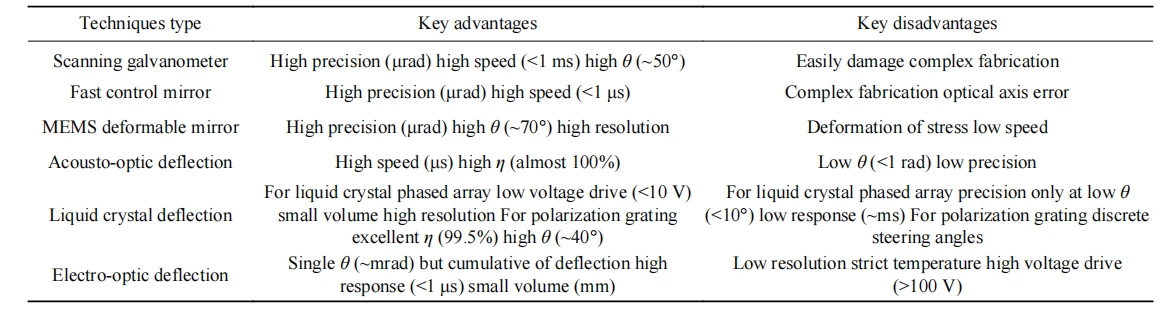
Tabella 1 Paragun ta ' raġġ deflessjoni teknoloġiji
Sommarju
Komunement użat mekkaniku mikro-elettromekkaniku deformabbli mirja, veloċi riflessjoni mirja u skannjar galvanometri bidla id-direzzjoni tal- /emitted optical axis through mechanical means. Their accuracy can reach microradians and the deflection angle can reach dozens of radians. They have wide application prospects in medicine and other fields. . However, hemm hemm problemi bħal kumpless struttura, bulky size, and high energy konsum. Due to the large size of adaptive optical systems, MEMS deformable mirrors at home and abroad are mainly used in the imaging field. In the field of beam deflection, it is difficult to meet the needs of small-scale spaceborne environments. to meet the high requirements of chemicalization and lightweight.
Acousto-optic deflection equipment has a large working bandwidth, but it is difficult to meet the deflection accuracy of microradians, and it has high requirements on the wavelength, angle and energy of the incident light and consumes large energy losses.
Metodi bħal bħal likwidu kristall fażijiet arrays u microlens arrays have low power consumption and low driving voltage, but they have slow response speed, discontinuous angular deflection, large deflection angles but low deflection efficiency at large angles, making it difficult to meet the task requirements of large-bandwidth transmission.
Compared with other technologies, beam deflectors based on electro-optic crystals have the advantages of arbitrary deflection angle, small size, fast response speed, and high sensitivity. They are considered to be the most suitable for realizing one of the leading directions of high-speed light deflection technology. Among various types of electro-optical materials, electro-optical deflectors based on KTN crystals have the advantages of large-angle deflection, fast response speed, high deflection efficiency, high deflection accuracy, wide-bandwidth operation, etc., and have greater potential in applications in fields such as space optical communications, becoming a Research hotspots around the world. On the one hand, the subsequent work must analyze and study the growth characteristics and conditions of KTN crystals to grow high-quality crystals with uniform composition and regular shape; on the other hand, we must gradually study the microscopic deflection mechanism of KTN crystals, which is very important. practical significance.


